
8K TVs are in the shops, and more streaming services now mention 8K. But is it worth chasing in 2026, or is 4K still the sweet spot? This is an honest comparison: when you will actually see the difference, what 8K asks of your home setup, and who should bother.
4K vs 8K at a glance
| Compared | 4K (Ultra HD) | 8K |
|---|---|---|
| Resolution | 3840 × 2160 | 7680 × 4320 |
| Total pixels | About 8.3 million | About 33 million |
| Recommended speed | 25 Mbps | 50 Mbps |
| TVs | Standard on almost every new TV | Mostly large, premium models |
| Content | Widely available | Limited, growing slowly |
| Home network | Good Wi-Fi or cable | Cable strongly recommended |
How much sharper is 8K really?
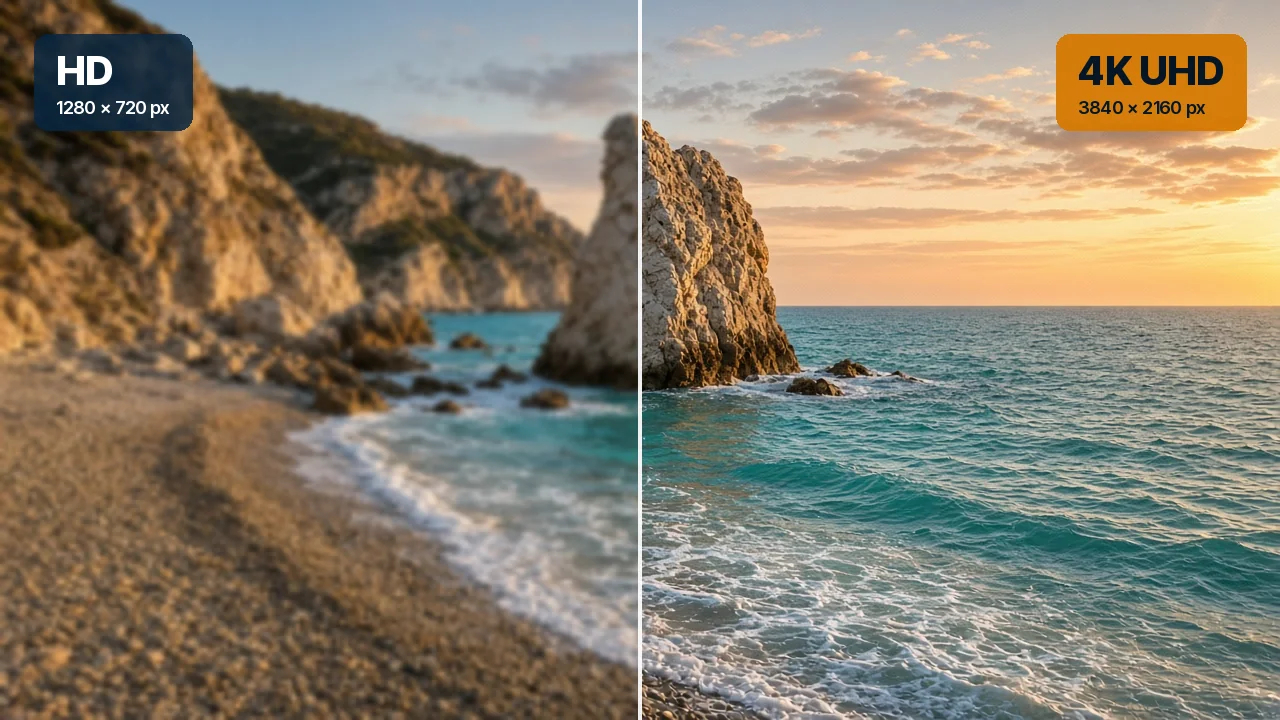
On paper, 8K has four times as many pixels as 4K. In your living room, how much of that extra detail you can see depends on two things: the size of the screen and how far away you sit.
Human eyesight has limits. Beyond a certain distance, individual pixels become too small to tell apart, and extra resolution stops making a visible difference. That point arrives sooner on smaller screens.
- On a 55-inch TV viewed from a typical sofa distance of two to three metres, most people see little or no difference between good 4K and 8K.
- On a 65 to 75-inch TV, some viewers notice extra crispness in fine textures, landscapes and text, especially when sitting closer.
- On 85 inches and above, or with a close seating position, 8K’s advantage becomes easier to see.
In other words, 8K is a big-screen technology. If your TV is 55 inches or smaller, 4K already gives you about as much detail as your eyes can use at normal distances.
What is actually available in 8K in 2026?
This is where expectations need managing. Most television around the world is still produced and broadcast in HD or 4K. Native 8K material exists, particularly nature and travel footage, demonstration content and some special events, but it remains a small slice of what is on.
Live channels in particular are almost always HD or 4K, because broadcasting in 8K requires new cameras, production equipment and far more bandwidth at every stage.
That does not make an 8K TV pointless. It means most of what you watch on one will be 4K or HD content that the TV upscales. On an IPTV service that includes 8K, you get 8K where the source supports it and the best available quality everywhere else.
Upscaling: why 8K TVs make 4K look good
Every 8K TV includes a processor that enlarges lower-resolution pictures to fill its screen. Modern processors are remarkably good at this. They sharpen edges, reduce noise and fill in detail convincingly.
The practical result is that a good 8K TV often makes 4K content look excellent, sometimes better than the same content on a cheaper 4K TV. So part of what you pay for with 8K is the premium processing that comes with it, not just the pixel count.
What 8K asks of your internet and home network
8K streams carry far more data than 4K. Even with efficient modern codecs, you need a fast and, crucially, stable connection:
- HD 10 Mbps
- 4K 25 Mbps
- 8K 50 Mbps
- Measure where you watch. Speed at the router means little if the TV is two rooms away on Wi-Fi.
- Use a cable for 8K. An Ethernet connection from the router to the TV removes most of the variables. See Wi-Fi vs Ethernet for IPTV.
- Test at peak times. Evening speeds can be lower than daytime ones.
The hardware checklist for 8K
- An 8K TV with a 7680 × 4320 panel.
- 8K-capable decoding in the TV or player, supporting modern codecs such as HEVC or AV1.
- HDMI 2.1 ports and cables if you use an external box. If you use the TV’s own app, no cable is involved.
- Up-to-date firmware and apps, which often add codec support and fix playback issues.
Our page on 8K IPTV in Cyprus goes through each requirement in more detail.
Who should choose 8K?
- You are buying a very large TV (75 inches or more) or you sit close to the screen.
- You have a fast, stable connection of at least 50 Mbps and can run a cable to the TV.
- You enjoy nature, travel and spectacle where fine detail shines.
- You want the best upscaling for everything else you watch.
Who should stay with 4K for now?
- Your TV is 65 inches or smaller and you sit at a normal distance.
- Your connection is below 50 Mbps, or the TV is far from the router on Wi-Fi.
- You mainly watch live channels, news and series, most of which are produced in HD or 4K.
- You would rather spend the difference on a better soundbar or a larger 4K screen.
Common myths about 8K
- “8K makes everything look four times better.” It has four times the pixels of 4K, but how much of that you see depends on screen size and distance. On most living-room setups the improvement is modest.
- “You need 8K to future-proof.” A good 4K TV will stay useful for many years, because most content is still produced in HD and 4K. Buy 8K for the screen size and processing, not out of fear of missing out.
- “Any fast connection will do.” Headline speed is only half the story. 8K needs that speed consistently, at the TV, at peak times.
- “8K needs a special subscription.” Not with us. HD, 4K and 8K are included on every plan at no extra cost.
Our verdict for 2026
For most homes, 4K remains the sweet spot in 2026. It is affordable, widely supported, needs a reasonable 25 Mbps, and on typical screen sizes it delivers about as much detail as you can see. Getting your TV picture settings right will usually make a bigger difference than moving to 8K; our guide to the best TV picture settings for 4K IPTV shows how.
8K makes sense if you already own, or are about to buy, a very large 8K TV and have the connection to feed it. In that case it is worth having, and you will also benefit from the TV’s superior upscaling.
You do not have to choose on our plans
Every IPTV Cyprus plan includes HD, 4K and 8K. There is no 8K upgrade fee. If you watch on a 4K TV today and move to 8K next year, nothing about your plan changes. Plans start at €19, or €6.25 a month on the 12 Months plan.
Frequently asked questions
Can I watch 8K on a 4K TV?
You can play the stream, but you will see 4K, because that is the most your screen can display. The picture will still look excellent.
Does 8K use more data?
Yes, considerably more than 4K. That is why we recommend at least 50 Mbps and a wired connection for 8K.
Is it worth buying an 8K TV just for IPTV?
Only if you want a very large screen or sit close to it. For most people, a good 4K TV with well-adjusted picture settings is the better value in 2026.
See exactly what you need on our 8K IPTV page, compare plans on our IPTV packages page, or contact us to check your TV. For the full overview, visit IPTV Cyprus.